Week 1: Lecture 1-3
Week 1: Lecture 1-3
Lecture 1

Phonetics > Phonlogy > Morphology > Syntax > Semantics > Pragmatics
Phonetics: Phonetics is a branch of linguistics that studies how humans produce and perceive sounds.
Phonology: Phonology is the branch of linguistics that deals with systems of sounds.
Morphology: In linguistics, morphology is the study of words, how they are formed, and their relationship to other words in the same language.
Syntax: In linguistics, syntax is the study of how words and morphemes combine to form larger units such as phrases and sentences.
Semantics: Semantics is the study of reference, meaning, or truth.
Pragmatics: In linguistics and related fields, pragmatics is the study of how context contributes to meaning.
N-grams
Unigram: Frequencies of Letters or Words
Bigram: Frequencies of Letters or Words given previous Letter or Word
Trigram: Frequencies of Letters or Words given 2 previous Letters or Words
The larger the n-gram, lesser the bias. Bias of a 100-gram model is lowe than 3-gram as it assumes less but has higher sensitivity to the input data.
Lecture 2
- Regular Expresion: A regular expression is a sequence of characters that specifies a match pattern in text. Usually such patterns are used by string-searching algorithms for "find" or "find and replace" operations on strings, or for input validation.
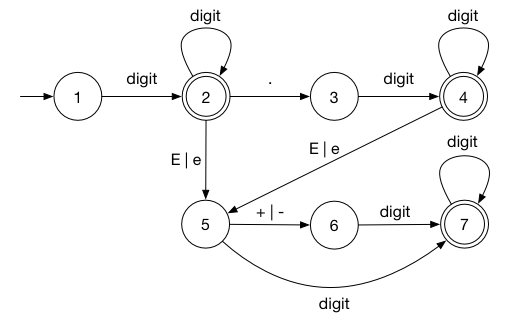
- Finite State Models: A finite-state machine or finite-state automaton, finite automaton, or simply a state machine, is a mathematical model of computation. It is an abstract machine that can be in exactly one of a finite number of states at any given time.
- context free grammar: A context-free grammar is a set of recursive rules used to generate patterns of strings. Example of a rule:
-
Chomsky Normal Form: a context-free grammar, G, is said to be in Chomsky normal form if all of its production rules are of the form: , or , or
-
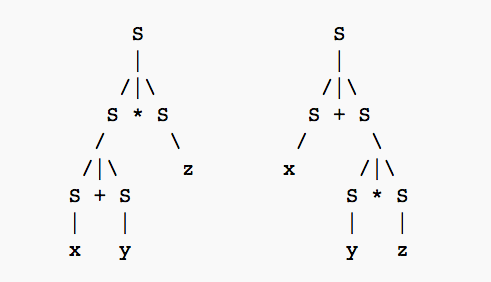
Ambiguity: Generating from grammar can create the same sentence with different parse tree.
-
Dependency Parsing: Dependency parsing is a linguistic analysis technique used in natural language processing to uncover grammatical relationships between words in a sentence. It involves parsing a sentence's structure to create a tree-like representation that shows how words depend on one another.
Leture 3
Applications of n-gram models:
- Language ID
- Search ENgines
- Indexers
- Text-to-speech
- Text Categorization
- Topic Segmentation
- Spelling Correction
- Speech Regognition
- Language Generation
- Machine Translation